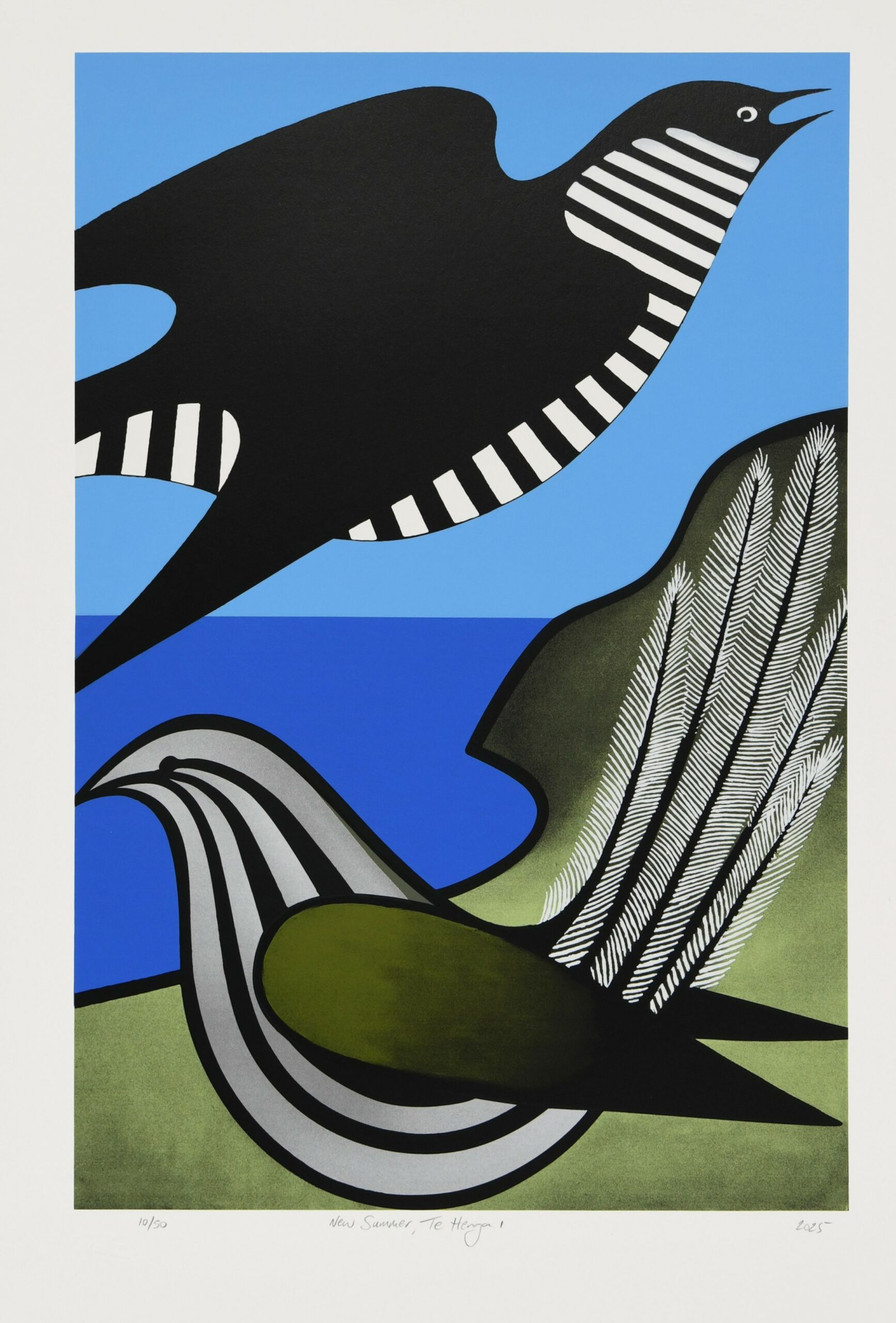
The Estate of Don Binney has released two new limited edition silk screenprints, based on his 1965 painting New Summer, Te Henga, using the same process and screenprinting specialist the artist used for his later limited edition works.
New Summer, Te Henga I uses the classic ‘Binney blues’ which the artist consciously chose for a number of his works; the second variation adopts the golden tones of his early Fern Bird paintings.
About the Artist
Don Binney needs little introduction to art lovers – or the New Zealand public – so distinctive are his iconic paintings and drawings of birds and landforms. In a career spanning more than 50 years, his commitment to ornithology, environmental issues and spiritual connection with the land drove his art practice.
Binney was Head of Painting at the Elam School of Fine Arts in Auckland, retiring in 1998 after 24 years of teaching. He exhibited continuously from the 1960s until his death in September 2012, aged 72. After retiring, he continued to focus full time on his art, travelling extensively, especially within New Zealand and to places of spiritual significance internationally. From 2002, he worked increasingly in charcoal and colour pencil because of its portability and simply because he loved the intimacy of the medium.
His perspective on landforms was as distinctive as the symbolism of his stylised birds. After becoming identified primarily for capturing the essence of endemic and some introduced birds in his art, he set them aside for many years as he investigated other media – including photography and collage – and diverse subjects. In later years he discovered there were still concepts to explore through this combination of his deep knowledge of ornithology and his art, and in 1999 he began to produce new bird series – as sought after as the early images.
In her book New Zealand Art – A Modern Perspective, Elva Bett described Binney as a pivotal artist ‘of unusual sensitivity and insight’, with clear light and sharp definition creating linear patterns to structure his compositions. That was in 1986. Although his paintings remained sought after through the 1980s and 1990s, there was a strong resurgence in collector interest in his final decade of work, including the finely crafted pencil drawings he favoured for their portability and the potential to work directly in the landscape. He is regarded among the most collectible names in New Zealand art.
The Diversion Gallery was principal agent for Don Binney in the six years before he passed away in 2012, and represents the Estate – with a small number of works for sale. Works from the Binney studio and family collection were released to initiate a project for a major book on Don Binney, ultimately resulting in Don Binney – Flight Path by Gregory O’Brien (AUP) in 2023, winning an Ockham Book Award in 2024.
We have copies of the beautiful volume Drawing the Waitakere Coast, (Random House) ($35) in which Don personally described in his own words, his journeys both artistic and literally over those pathways on the coast west of Auckland, which were his best known artistic territory. He created a suite of intimate drawings especially to illustrate the book, a non-selling show which toured regional public galleries from 2010 to 2012 and was shown in a tribute exhibition at his ‘alma mater’ Kings College in 2013.
Recent Works
In the last decade of his life and career, Don Binney increasingly used pencil, charcoal and colour pencil to capture the essence of landscape and birdlife with immediacy; occasionally working these up to the paintings for which he remains best known. He used colour pencil or pastel over heavy watercolour paper with deceptive simplicity, skimming over the tooth of the paper so the white of the paper conveyed the effect of light on water or foliage.
He focused on two regions in particular: the Waitakere Coast west of Auckland which was his best-known ‘territory’ throughout his career; and the Marlborough Sounds, which ‘began to reveal itself’ after his first Marlborough solo exhibition, Vintage Binney, at The Diversion Gallery in 2003, prompting several visits and an evolving series of both drawings and paintings. This was a breaking of new ground by a senior artist known for particular loyalty to places which touch his life deeply. It was evident here in his discovery of the barely populated landforms, the crouching islands, the changing moods of the Marlborough Sounds, the birdlife in bush and on water, the soft southern light.
He also visited the bird sanctuary Hauturu – Little Barrier Island – being the long-time patron of its Supporters’ Trust, and continued to produce works to aid conservation projects like this and Marlborough’s Kaipupu Point sanctuary, persisting despite ill health in the last weeks of his life, in his determination to lift the profile and financial support of environmental causes.
Limited Edition Prints
Don Binney only rarely produced limited edition lithographs and screenprints. We have a few available from the studio collection, including a striking 2004 lithograph Edward Kaiarara VII, from his Effigy series of crowned heads based on coin imagery, referring to colonial impact on the New Zealand landscape. The bird sanctuary of Little Barrier Island/Hauturu (Don Binney was patron of the Supporters’ Trust) notably sits above the crown – contrary to royal protocol where nothing is above the Crown.
The lithograph Beyond Wainamu was created to offer as a fundraiser for environmental projects; the singular print available has an unusual annotated signature, probably why Don Binney retained it in his studio collection; it has only recently been framed and made available.
More About the Artist
Career biographical notes 1995-2005:
1995: Awarded OBE for services to the Arts. Remuera Jug & Other Suites, Solo Show – Elaine Meyer/ASA, Auckland.
1996: Don Binney – Recent Works, A Selection, Fine Arts Gallery, University of Canterbury, Christchurch. Sabbatical leave to UK. Grace and Peace to you from God – stained glass window, St Thomas’ Anglican Church, Tamaki.
1997: Ancient Earth, Solo Show, Brooke-Gifford Gallery, Christchurch.
1998: Retired as Head of Painting, Elam School of Arts, University of Auckland, after twenty-four years’ teaching. Sites of Significance, Solo Show, Judith Anderson Gallery, Auckland.
1999: Revisiting, Solo Show, Brooke-Gifford Gallery, Christchurch. Preface to Highway One, photo-survey by Bret de Their. Millennium Medal, Waitakere City. The Dream Collectors, Te Papa Tongarewa, Museum of New Zealand, Wellington.
2000: Nga Motu, Solo Show, Milford Galleries, Auckland. 25th Anniversary Survey, Brooke-Gifford Gallery, Christchurch. 2001: Cross-Water, Solo Show, Milford Galleries Dunedin. Michaelmas, Solo Show, Brooke-Gifford Gallery, Christchurch.
2002: Paper presented: John Kinder: Founding Vision, Local Realities – Eighth annual Kinder Society Lecture, St John’s Theological College, Auckland. Landscape, Two-artist Show (with Gerda Leenards) Artis Gallery, Auckland. Vintage Binney, Solo Show, The Diversion Gallery, Grove Mill Winery, Marlborough.
2003: Nga Manu/Nga Motu, Monograph with 75 colour plates; Damian Skinner, Auckland University Press. 12: dialogues with time, Chrysalis Seed Trust Group Exhibition curated by John Stringer, Centre for Contemporary Art, Christchurch. Forty Years On, survey exhibition curated by Damian Skinner, Dowse Art Museum, Lower Hutt. Then and Now, Solo Show, Williams Gallery, Petone. ’63 to Sixty-three, Self-sourced Retrospective, Brooke-Gifford Gallery, Christchurch.
2004: Forty Years On, survey exhibition, Auckland Art Gallery, touring to Waikato and Manawatu. ‘63 to Sixty-three, Millennium Public Art Gallery, Blenheim. Representation and Reaction, curated by Peter Shaw, Sargeant Gallery, Wanganui; to tour Porirua and Auckland.
2005: Forty Years On, ends tour at Hawkes Bay Museum and Art Gallery. Rakiura drawings, Dancing Star Foundation exhibit, Southland Museum and Art Gallery. There Before the Gulf, Solo Show, Artis Gallery, Auckland. 30th Anniversary Survey, Brooke-Gifford Gallery, Christchurch. Judge, Pumphouse Art Award, Takapuna. Deep Sounds, Solo Show, The Diversion Gallery, Marlborough.
2012: Ocean’s Edge, a survey exhibition incorporating the Drawing the Waitakere Coast Suite, at the Millennium Public Art Gallery, Blenheim co-curated by The Diversion Gallery.
People look at his coastal landscapes and ask: ‘Where is this place?’ Binney answered: ‘It is wherever resonates with you.’ It is undeniably New Zealand, and encourages us to ponder on who we are as New Zealanders. His last and largest screenprint, Mill Creek, Rakiura, was a case in point. Although literally of a favourite bay in Stewart Island, it represents different places to different viewers – some see Golden Bay in it, others the Otago coast, Taranaki, Marlborough, or Coromandel. It was always about resonance.
2018: Flight Path, works from the Binney studio collection and family collection, towards a major monograph by Gregory O’Brien on the artist.
2023: Earth, Sea, Light at The Diversion, including works released from the Binney Estate collection.